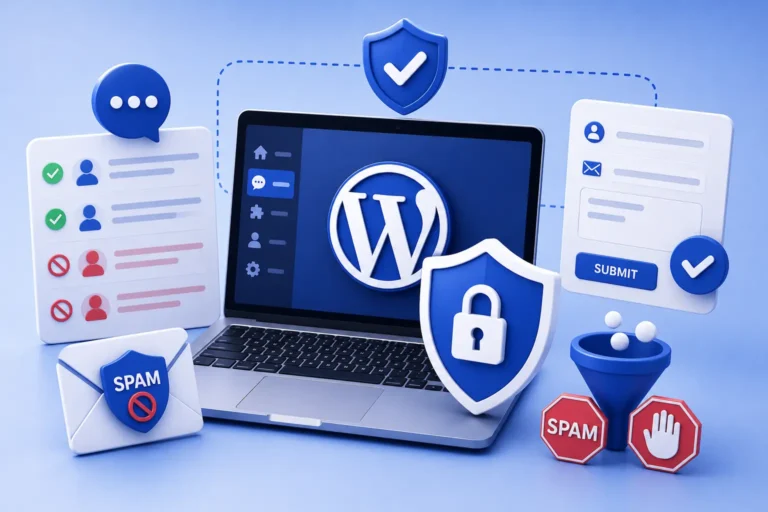
The fundamentals of WordPress security have not changed. What changed is speed: the window between a vulnerability becoming public and it being exploited at scale keeps shrinking. Our security and malware removal service is built around that reality rather than around an annual review.
This guide covers what automation actually changed about the threat, what it did not, and where to put your effort.
What Automation Changed
Attacks against small business sites were always automated. Nobody was hand-picking a plumber in Ohio. The difference now is the quality of that automation: faster turnaround from disclosure to weaponised exploit, better reconnaissance, and more convincing social engineering.
The practical consequence is that “we update monthly” has become genuinely risky in a way it was not a few years ago. A critical plugin vulnerability can be exploited widely within days of disclosure.
Phishing Got Much Harder to Spot
The reliable tells of a phishing email were bad grammar, awkward phrasing, and generic greetings. Those tells are gone. A convincing message referencing your actual hosting provider, your actual plugin stack, and your actual name is now cheap to produce.
This matters because credential theft bypasses every technical control you have. A firewall does not help when someone signs in with a valid password.
What Has Not Changed
This is the part that gets lost in alarming coverage. The entry points are the same ones they have always been.
- Outdated plugins and themes: still the single largest cause of compromised WordPress sites
- Weak or reused passwords: still trivially defeated by credential stuffing
- No two-factor authentication: still the difference between a stolen password mattering and not
- Nulled premium plugins: still a reliable way to install malware deliberately
- Excessive admin accounts: still expanding the attack surface for no benefit
- Abandoned staging sites: still running forgotten, unpatched copies of your production code
Nothing on that list requires sophisticated defence. It requires someone to actually do it, consistently.
Where to Put Your Effort
Shorten Your Patch Window
The most valuable change most sites can make is reducing the time between a security release and it being applied. Weekly is defensible for most business sites. Monthly is increasingly not, at least for security releases specifically.
Make Credentials Hard to Use
Two-factor authentication on every administrator account removes most of the value of a stolen password. It is the highest-return security control available to a WordPress site and it takes minutes to enable.
A Realistic Baseline
- Enable two-factor authentication for every admin and editor account
- Apply security updates within days, not weeks, and automate the routine ones
- Remove unused plugins, themes, and user accounts entirely rather than deactivating them
- Take off-site backups and test a restore, because an untested backup is a hope
- Enable monitoring so you find out about problems before your customers do
- Give people the least privilege their job needs, not administrator by default
- Review who still has access after anyone leaves the business
Assume You Will Need the Backup
No defence is perfect, and the sites that recover well are the ones that prepared to recover. That means off-site backups, a known restore procedure, and someone who knows where the credentials are before the outage rather than during it.
If your site has already been compromised, our hacked-site recovery service covers cleanup and hardening. If it has not, a free audit is a cheaper way to find out what is exposed.
Get a free audit covering security, updates, backups, and performance gaps. Takes 60 seconds to request and costs nothing.