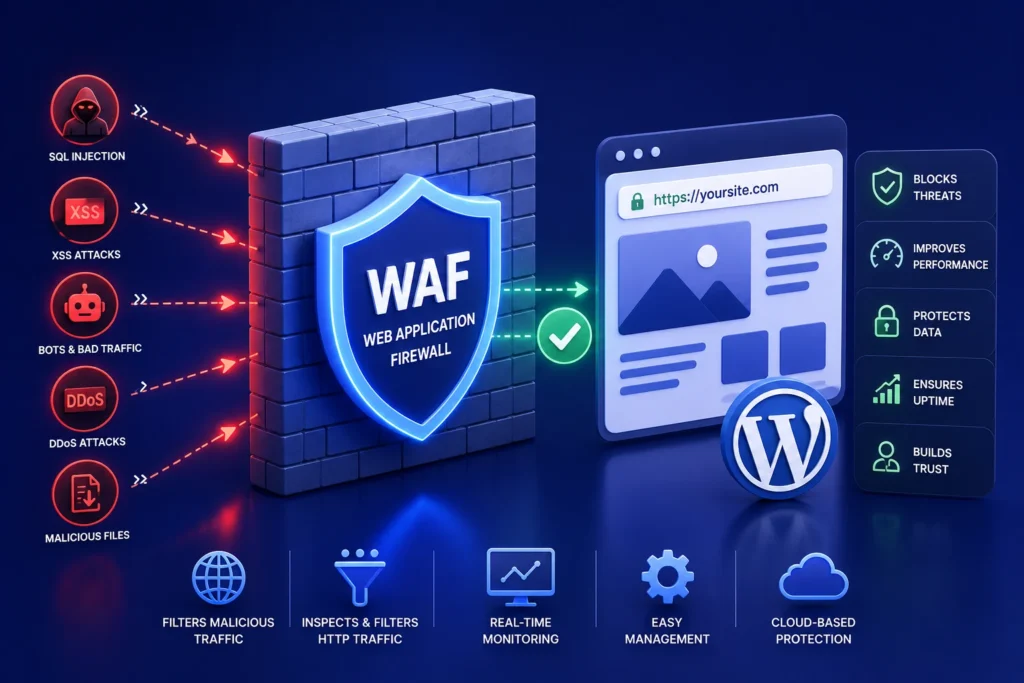
If you would rather have this handled for you, our WordPress security service takes care of this end to end. Imagine a security guard standing at the entrance to your website, checking every visitor and turning away anyone with harmful intent before they can get inside. That is essentially what a web application firewall does, and in 2026 it is a core part of protecting any WordPress site.
Many site owners have heard the term but are not sure what a firewall actually does or whether they need one. This guide explains what a web application firewall is, how it protects WordPress, and why it belongs on every site.
What Is a Web Application Firewall?
A web application firewall, often shortened to WAF, sits between your website and incoming traffic. It inspects every request before it reaches your site and blocks anything that looks malicious.
Unlike a traditional network firewall, a WAF understands web-specific attacks. It recognizes the patterns of things like hacking attempts, malicious bots, and known exploits, and stops them at the door.
The result is that harmful traffic is filtered out before it can ever interact with your WordPress installation.
How a WAF Protects Your Site
A web application firewall defends against a wide range of common threats. It works quietly in the background, blocking attacks around the clock.
- Blocks brute-force attacks on your login page
- Filters out malicious bots and automated scanners
- Stops common exploits such as injection and cross-site scripting attempts
- Absorbs and mitigates traffic-flood attacks designed to take your site offline
- Reduces the load on your server by turning away bad traffic early
A firewall does not wait for an attack to succeed and then clean up. It stops the attack before it ever reaches your site. Prevention beats cure every time.
Why Every WordPress Site Needs One
Some owners assume firewalls are only for large or high-profile websites. In reality, most attacks are automated and target sites of every size indiscriminately.
Because WordPress is so widely used, it is constantly probed by bots looking for any vulnerable site. A firewall is one of the most effective ways to shut down these automated attacks before they find a weakness. It complements other measures like updates and strong logins, as covered in our guide on WordPress security hardening.
Without a firewall, your site relies entirely on its internal defenses to catch every threat. With one, most threats never get that far.
A WAF Is One Layer, Not the Whole Solution
As powerful as a web application firewall is, it works best as part of a layered security approach. No single tool can do everything.
A firewall filters incoming traffic, but you still need prompt updates, strong passwords, two-factor authentication, malware scanning, and reliable backups. Together, these layers cover far more than any one of them alone.
Think of the firewall as the outer wall of your defenses. It stops most attackers at the perimeter, while your other measures protect what is inside.
Not All Firewalls Are Equal
The term web application firewall covers a range of solutions, and they are not all equally effective. Knowing the difference helps you understand what real protection looks like.
A basic firewall applies a fixed set of rules to block obvious threats. That is useful, but attackers evolve constantly, and a firewall that is never updated gradually falls behind the latest techniques.
A well-managed firewall is different. Its rules are kept current as new threats emerge, so it continues to block attacks that a static setup would miss. It is also tuned to your site, reducing the risk of accidentally blocking legitimate visitors.
This is why a firewall is most effective as part of a maintained, monitored setup rather than a one-time installation. The threats change every week, and your protection needs to keep pace with them. A firewall that is actively managed stays effective, while one that is set and forgotten slowly loses its edge.
Frequently Asked Questions
What does a web application firewall do?
It inspects incoming traffic to your site and blocks malicious requests, such as hacking attempts, bad bots, and known exploits, before they can reach your WordPress installation.
Do I really need a firewall for a small website?
Yes. Most attacks are automated and target sites of all sizes. A firewall blocks these threats regardless of how large or small your site is.
Is a firewall enough to secure my site on its own?
No. A firewall is a powerful layer, but it works best alongside updates, strong logins, two-factor authentication, malware scanning, and backups.
Will a firewall slow down my website?
A good firewall has minimal impact on speed and can even help by blocking bad traffic that would otherwise burden your server.
For further reading, OWASP’s overview of web application firewalls offers helpful, authoritative guidance.
Put a Guard at Your Site’s Front Door
A web application firewall is one of the most effective defenses available for WordPress, blocking most attacks before they ever reach your site. Combined with other good security practices, it dramatically reduces your risk.
BlueBotts includes firewall protection and layered security in our maintenance plans, backed by monitoring and a real team. Request a free site audit or get in touch to protect your site.
Get a free audit covering security, updates, backups, and performance gaps. Takes 60 seconds to request and costs nothing.